Table of Contents
ToggleBlack kitchens carry a reputation for drama, sophistication, and boldness, but can they work in a small space without turning it into a cave? Absolutely. When approached with intentional design choices, black cabinetry, fixtures, and surfaces can actually make a compact kitchen feel more deliberate and defined. The key is balancing those dark tones with strategic lighting, reflective materials, and enough contrast to keep the room from closing in. This guide walks through twelve practical ideas for designing a small black kitchen that’s both functional and striking.
Key Takeaways
- Black kitchens don’t shrink small spaces—they anchor the design, creating visual clarity and a more intentional layout when paired with strategic lighting and bright accents.
- Use the 60-30-10 color rule: 60% black cabinetry, 30% neutral surfaces, and 10% accent colors to prevent small black kitchens from feeling oppressive or overwhelming.
- Under-cabinet LED lighting, reflective surfaces like polished chrome and glass, and light countertops are essential for balancing dark tones and preventing a cave-like atmosphere.
- Flat-panel matte black cabinets with full-extension drawers maximize storage efficiency and hide imperfections better than glossy or decorative finishes in tight spaces.
- White quartz countertops paired with subway tile or geometric backsplashes provide high contrast and keep small black kitchen designs clean and contemporary.
- Budget-friendly updates like cabinet painting, hardware swaps, peel-and-stick backsplash tiles, and toe-kick lighting can transform a small black kitchen for $500–$3,000 without a full renovation.
Why Black Works Beautifully in Small Kitchens
Black has a way of hiding imperfections that lighter finishes can’t. Fingerprints, smudges, and minor dents disappear against matte black cabinets, which is a real advantage in a hardworking kitchen. The color also recedes visually when paired with brighter elements, creating depth rather than shrinking the space.
Contrary to common assumptions, black doesn’t always make a room feel smaller. It can anchor a design, giving the eye clear boundaries and making the layout feel more intentional. In compact kitchens where every inch counts, this visual clarity helps avoid the cluttered, chaotic feel that sometimes comes with trying to cram too much into a small footprint.
Small kitchens benefit from cohesive color schemes. A monochromatic black palette, cabinets, hardware, and accents, simplifies decision-making and creates a streamlined look. That unity makes the space feel larger and more considered, especially when contrasted with a single bright element like a white countertop or stainless steel appliances.
Finally, black kitchens age well. Trends in hardware, backsplash patterns, and countertop materials come and go, but black cabinetry remains a versatile backdrop. Homeowners can swap out smaller elements over time without needing a full overhaul, which keeps renovation costs manageable.
Essential Design Principles for Small Black Kitchens
Designing a small black kitchen requires more forethought than a larger space. The margin for error is slimmer, and poor choices show up faster.
Start with a focal point. Whether it’s a range hood, open shelving, or a statement backsplash, giving the eye somewhere to land prevents the room from feeling flat. In a galley kitchen, this might be the back wall. In an L-shaped layout, it could be the corner or an accent countertop.
Use the rule of thirds for color distribution. Aim for roughly 60% black (cabinets and larger surfaces), 30% neutral (countertops, walls, or flooring), and 10% accent (hardware, lighting, or a pop of color). This ratio keeps black from overwhelming the space while maintaining its impact.
Plan for vertical storage. Small kitchens demand efficient use of wall space. Black upper cabinets that reach the ceiling draw the eye upward and provide storage that would otherwise go unused. Installing cabinets to the ceiling also eliminates the dust-collecting gap that shorter units leave behind.
Balancing Dark Tones with Light and Texture
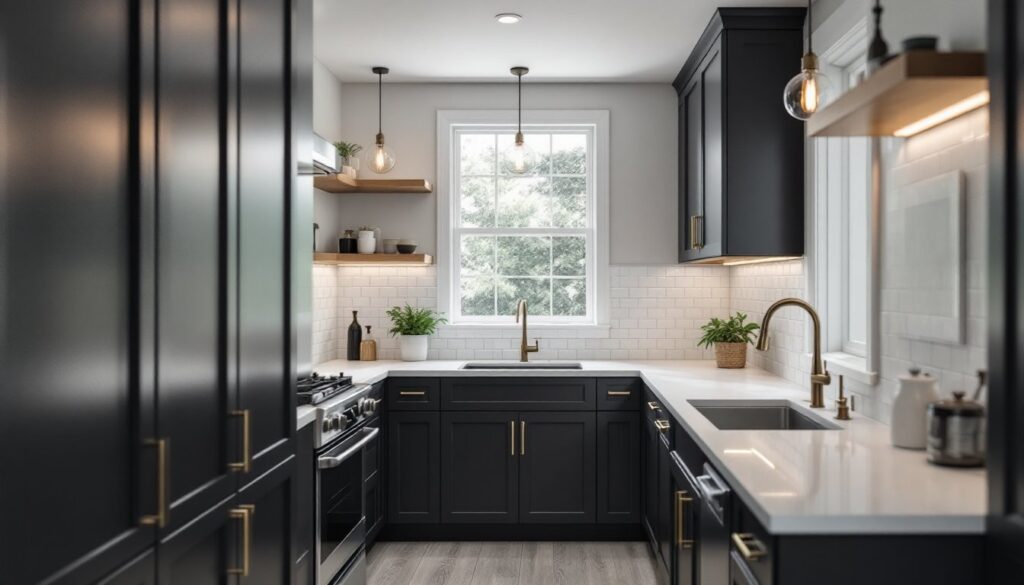
Dark finishes need counterweights, or the room risks feeling oppressive. Start with reflective surfaces: polished chrome faucets, glass cabinet inserts, or glossy subway tile backsplashes bounce light around the room and break up the heaviness of matte black cabinetry.
Texture variation is equally important. Pair smooth black lacquered cabinets with rough-hewn wood shelving, or combine matte black lower cabinets with high-gloss upper cabinets. These contrasts create visual interest without introducing more colors.
Consider using mixed materials. A black kitchen with all-black cabinets can feel monotonous, but swapping in a natural wood island base or open metal shelving introduces warmth and dimension. Brass or copper hardware adds another layer of contrast, especially against matte finishes.
Finally, don’t underestimate white or light gray as balancing agents. A white quartz countertop or light-toned flooring provides breathing room and prevents the design from feeling too heavy. Many successful contemporary kitchen backsplashes use white or cream grout lines to soften dark tile and add grid-like structure.
Black Cabinet Styles That Maximize Space
Not all black cabinets are created equal, especially in tight quarters. Flat-panel (slab) doors work best in small kitchens. They eliminate visual clutter, keep sightlines clean, and are easier to wipe down than cabinets with recessed panels or decorative trim.
Shaker-style cabinets can also work, but stick to a narrow frame (under 2 inches) to avoid a bulky look. Raised-panel doors, common in traditional kitchens, tend to feel too busy in compact spaces and make the room look dated faster.
Matte finishes are more forgiving than high-gloss in small kitchens. While gloss reflects light well, it also shows every smudge, scratch, and uneven wall. Matte black hides imperfections and gives the kitchen a more refined, contemporary feel.
For base cabinets, consider drawers over doors. Full-extension drawer glides make it easier to access items in the back, which is critical when you’re working with limited cabinet depth. Soft-close hardware is worth the upcharge, it prevents slamming and extends the life of the cabinet boxes.
If the budget allows, custom or semi-custom cabinets offer better space optimization than stock units. Filler panels, oddly sized corners, and wasted vertical space all eat into usable storage. A cabinet maker can build to exact dimensions, incorporating pull-out spice racks, appliance garages, or corner drawers that stock cabinets can’t accommodate.
Open shelving is another option, but use it sparingly. One or two open shelves flanking a window or above a sink can lighten the visual weight of black cabinets without sacrificing much storage. Just be prepared to keep those shelves tidy, clutter shows up fast against a dark backdrop.
Countertop and Backsplash Pairings for Black Kitchens
Countertops set the tone. White quartz is the most popular pairing with black cabinets for good reason: it’s durable, non-porous, and creates high contrast without clashing. Brands like Caesarstone and Silestone offer consistent patterns with minimal veining, which keeps the look clean.
For a warmer feel, butcher block or light wood countertops soften the starkness of black. Maple and birch hold up well under regular use, but they require periodic oiling and aren’t as stain-resistant as engineered stone. Install a butcher block island top and use quartz or solid surface for perimeter counters if maintenance is a concern.
Marble brings elegance but demands upkeep. It stains, etches, and scratches more easily than quartz or granite. If the aesthetic is worth it, opt for honed (matte) marble rather than polished, it hides wear better and feels less formal.
Backsplashes in small black kitchens should either blend or contrast sharply: anything in between muddies the design. White subway tile (3×6 inches) with dark grout is a classic, low-cost option. It’s widely available, easy to install, and works with both modern and transitional styles.
For more visual interest, consider hexagonal or geometric tile in white, cream, or light gray. Patterned cement tile can work if kept to a small area, say, behind the range, but avoid covering every wall. In a small kitchen, too much pattern competes with the black cabinetry.
Metal backsplashes, like stainless steel or brushed brass sheets, reflect light and add an industrial edge. They’re easy to clean but show water spots, so they’re best suited to low-splash areas or homeowners who don’t mind regular wiping. Design resources on homify.com showcase a range of backsplash materials paired with dark cabinetry for additional inspiration.
Lighting Strategies to Brighten Small Black Spaces
Lighting can make or break a small black kitchen. Under-cabinet lighting is non-negotiable. LED strip lights or puck lights installed beneath upper cabinets illuminate countertops, reduce shadows, and make food prep safer. Choose warm white (2700–3000K) to soften the starkness of black cabinets.
Recessed ceiling lights (also called can lights) should be spaced no more than 4 feet apart in a small kitchen. Use IC-rated housings if installing in an insulated ceiling. Aim for a total of 50–75 lumens per square foot to ensure adequate task lighting without glare.
Pendant lights add personality and fill the middle lighting layer that recessed lights miss. Hang them 30–36 inches above an island or peninsula to avoid head-bumping. Glass or open-frame pendants work better than solid shades in small spaces, they don’t block sightlines or make the room feel crowded.
Toe-kick lighting is an underused trick for small black kitchens. LED strips installed at the base of cabinets create a floating effect and add ambient light without taking up wall or ceiling real estate. It’s a subtle upgrade that makes a noticeable difference after dark.
If the kitchen has a window, maximize it. Skip heavy curtains in favor of sheer panels or no window treatment at all. Natural light is the best tool for preventing a black kitchen from feeling oppressive. For kitchens without windows, consider a solar tube (tubular skylight) if the layout allows. These can bring daylight into interior spaces where traditional windows aren’t an option.
Finally, install dimmer switches. Adjustable lighting gives flexibility for different tasks and times of day. A bright, fully lit kitchen is great for cooking: softer lighting works better for casual meals or entertaining.
Budget-Friendly Black Kitchen Updates for DIYers
A full black kitchen remodel can run $15,000–$40,000 depending on finishes and labor, but there are cheaper ways to test the look or refresh an existing space.
Painting existing cabinets is the most cost-effective transformation. Use a high-quality cabinet paint (Benjamin Moore Advance or Sherwin-Williams ProClassic) in a satin or semi-gloss finish. Matte paints look great but don’t hold up as well to scrubbing.
Prep is everything. Remove doors and hardware, clean all surfaces with a degreaser (TSP works well), lightly sand with 220-grit paper, then apply a bonding primer like Zinsser B-I-N or KILZ. Two coats of paint, sanded lightly between coats, will give a professional finish. Let each coat cure for 24 hours before handling.
Peel-and-stick backsplash tiles have come a long way. Products like Smart Tiles offer realistic subway tile and geometric patterns that hold up in low-moisture areas. They won’t replace real tile in a high-splash zone, but they’re a solid option for renters or DIYers on a tight timeline.
Swapping hardware is a low-effort, high-impact update. Matte black or brushed brass pulls and knobs run $2–$10 per piece. For a cohesive look, choose one finish and stick with it throughout the kitchen. Standard pulls are spaced 3 or 3.75 inches on center (measured between screw holes), so confirm sizing before ordering.
Open shelving can replace a few upper cabinets without a full renovation. Remove cabinet doors, fill the hinge holes with wood filler, sand smooth, and paint the interior. Install simple brackets (like Ekby from IKEA or heavy-duty L-brackets rated for the load) and add shelves cut from 1×10 or 1×12 lumber.
Finally, consider a removable vinyl wrap for appliances. Companies like Faux offer matte black vinyl that can cover a white or stainless fridge, giving a built-in look for a fraction of the cost. It’s not permanent and can be removed without damaging the original finish, making it a good option for renters or anyone testing a design direction.
For more ideas on maximizing tight spaces, many of the principles in tiny home kitchen design translate well to small urban kitchens. Experts at thekitchn.com also offer tutorials on cabinet painting and budget remodeling that pair well with these strategies. Additional renovation advice and design case studies appear regularly on remodelista.com, covering both high-end and DIY-friendly approaches.